



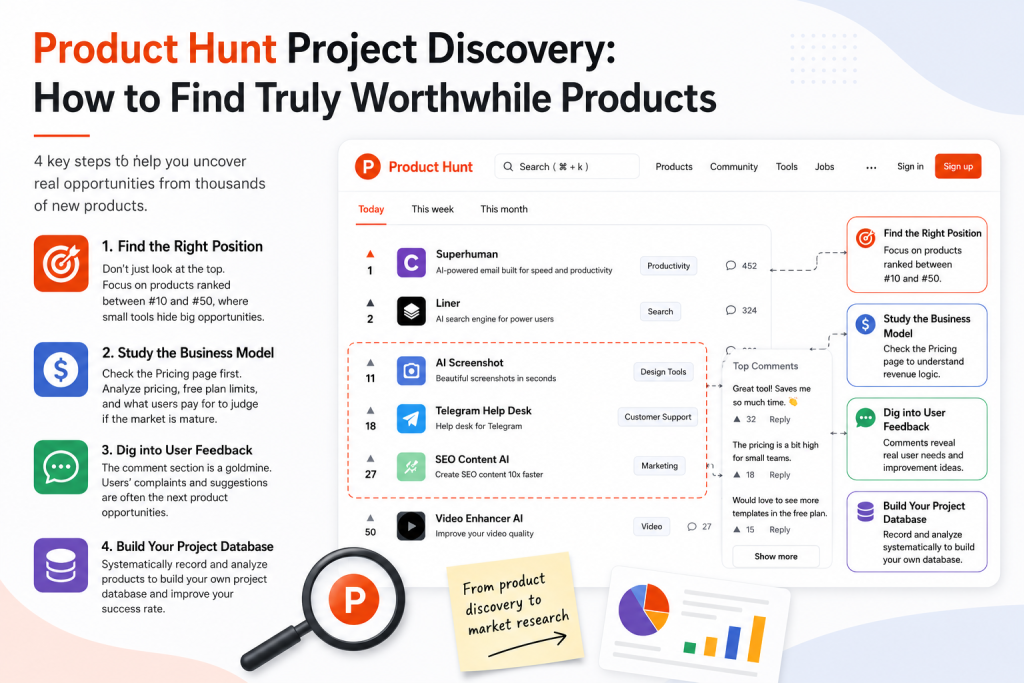
Introduction: Most people browse Product Hunt simply to “watch the show.”
Many independent developers have a habit: every day they open Product Hunt to see what AI tools were launched, who took first place, and which products are growing the fastest, then they quietly bookmark a few links, thinking, “Maybe I can do that in the future.”
But after a while, you’ll find that your bookmarks get longer and longer, but you start working on fewer and fewer projects.
The problem wasn’t a lack of execution, but rather a flaw in the research methodology.
Most people treat Product Hunt as a startup news website, focusing on the results: who became popular, who exploded in popularity, and who gained traffic. What they should really be studying is the process: what problem does this product solve, why are users willing to pay for it, has the market been validated, and do they have an opportunity to enter the market?
When I worked on projects later, I stopped treating Product Hunt as an information platform and started using it as a “demand database.” This is because a large number of new products appear there every day, and behind these products are essentially user problems that have already been validated.
For independent developers, the biggest risk is never competition, but rather spending three months developing a product only to discover that the market doesn’t even exist. Studying already launched products, rather than searching for projects based on gut feeling, significantly increases the success rate.
So in today’s article, we won’t talk about how to climb the charts or how to launch a Product Hunt campaign, but rather about something more important:
How to find truly worthwhile small products from Product Hunt.
First: Don’t focus on the top-selling products; the real opportunities are usually hidden in the middle.
When many people open Product Hunt for the first time, they focus their attention on the first item on the homepage.
Top-ranked products often have a strong visual impact: beautiful pages, rich features, numerous reviews, and even backed by a team, funding, and community support. After seeing them, many people’s first reaction is not “This project is good,” but rather “This is too complicated; I can’t do it.”
This feeling is normal, but the problem is: top-ranked projects are not necessarily suitable for independent developers.
Because what you see is the result, not the process. Many top-ranked products may have been preparing for months before their official launch, and may have even done user accumulation and marketing pre-launch activities in advance.
In contrast, I prefer to research products ranked between 10th and 50th on the day .
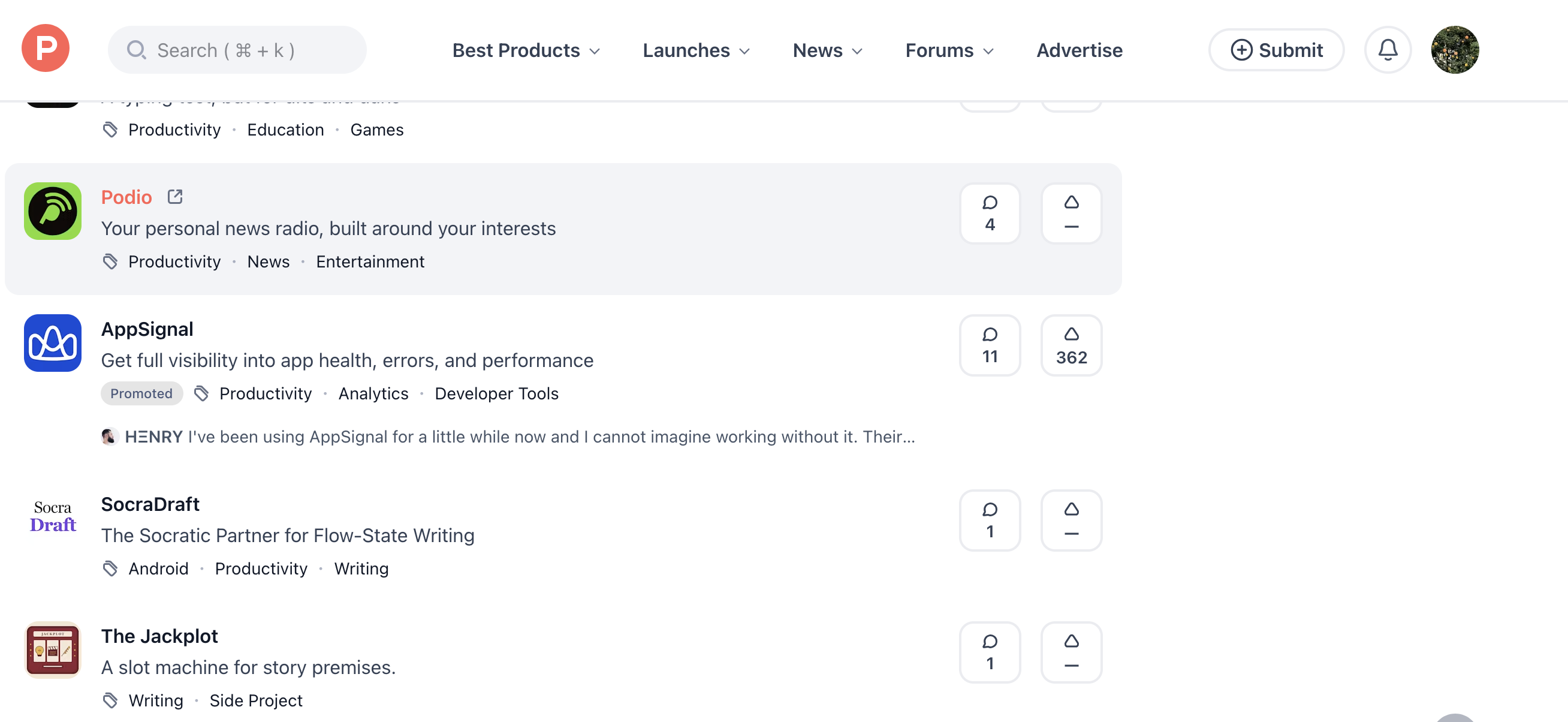
This area often features some very interesting gadgets. They might be a screenshot generator, a Telegram customer service plugin, an SEO automation assistant, or even just an optimization for a specific process.
These products typically share several common characteristics: clearly defined target users, a single problem to solve, a short development cycle, and already being used by some people.
For example, an app screenshot tool may not seem complicated, but it solves problems that developers encounter every day; an SEO automation tool may not have many functions, but it helps website owners save time on content production; a customer service plugin may only have a few core functions, but it can improve response efficiency.
The greatest value of these products lies not in their technology, but in:
They have proven that there is a need for them.
For independent developers, studying this type of product is more meaningful than studying large platforms because they are closer to reality and easier to verify.
Second: When disassembling a product, don’t look at the functions first, but rather figure out how to make money from it.
People with a technical background often fall into a habit when researching projects: after opening the product, they first study how it is implemented.
They will look at what technology stack is used, how the page is built, how the database is designed, how the interface is implemented, and even start thinking about the code structure directly.
But once you actually start making the product, you’ll find that while these issues are important, they’re not the first step.
The first step should be:
Why can this product make money?
When I research Product Hunt products now, I usually open the Pricing page first, rather than the homepage.
Because the price page is more accurate than the product description page.
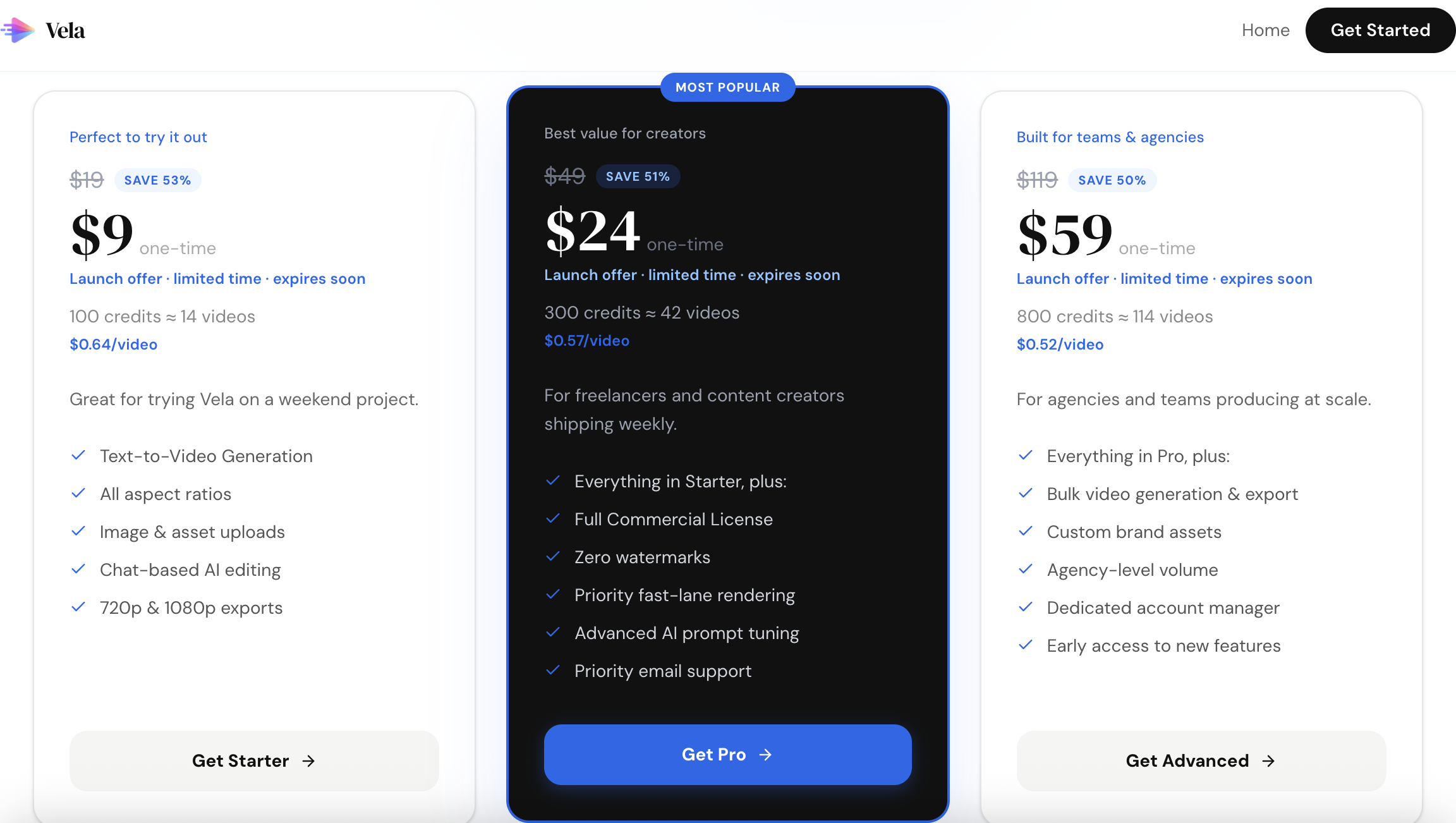
The homepage describes the vision, while the pricing page describes the business model. It tells you directly: why users upgrade, where the payment points are, and whether the market is mature.
The information hidden behind these designs is very important.
It tells you exactly what users are buying.
Many people think that users are buying “features”, but in reality, users are buying results.
Once you understand this, the way you research projects will completely change.
You won’t ask again:
“Can I make this feature?”
And they will start asking:
Why are users willing to continue paying?
This is the biggest difference between product thinking and development thinking.
Third: The comments section is often more valuable than the product itself, because users will directly tell you about opportunities.
Many people, when researching Product Hunt, only look at the product description page.
The truly valuable information is often hidden in the comments section.
Because the introduction is written by the team for users to see, while the reviews are written by users for the team to see.
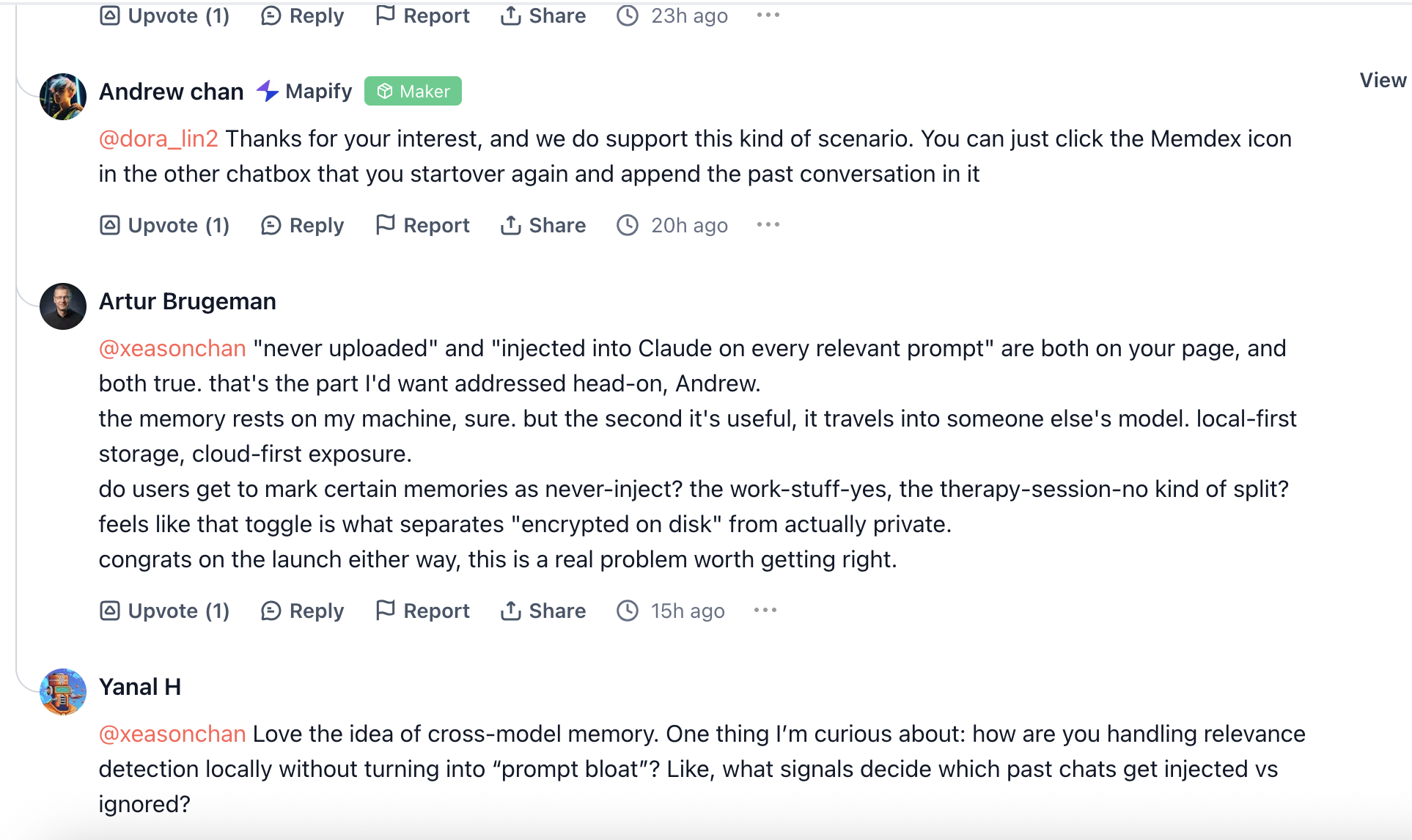
You’ll find a lot of real feedback here.
Some might say the product is great, but the price is too high; others might think the direction is good, but complain that there aren’t enough templates; still others might directly compare it with competitors, hoping to add certain capabilities.
These contents may seem like opinions, but in reality, they are the demands for the next generation of products.
When I analyze a product now, I create a special record sheet to translate user feedback into opportunities.
For example, if a user complains that there are too few templates, I won’t simply record it as “add more templates,” but will consider whether there is a vertical template market; if a user thinks the price is too high, I will consider the opportunity for a lightweight version; if a user says the learning cost is high, I will study whether the process can be redesigned.
After disassembling ten products in a row, you will notice a phenomenon:
Many problems keep recurring.
Screenshot tools repeatedly encounter template issues; SEO tools repeatedly show duplicate content; customer service and product staff repeatedly request statistical analysis.
When a problem appears in different products, it is no longer an isolated feedback, but a market signal.
Products that are truly worth making don’t necessarily come from inspiration.
Often, it stems from problems that users repeatedly complain about but that no one has ever truly solved.
Fourth: Build your own Product Hunt database to transform project finding from inspiration to a systematic process.
Many people browse Product Hunt every day, but the biggest waste is:
I forgot it as soon as I saw it.
I save ten products today, and start again tomorrow; next week I see similar projects, and then I repeat the process.
This method is very inefficient.
The truly effective method is to build your own project database.
It is recommended to record several core fields: product name, category, target users, payment method, advantages, disadvantages, entry difficulty, and whether it is worth doing.
For example:
| product | user | TOLL | Advantages | shortcoming | Enter? |
|---|---|---|---|---|---|
| AI Screenshot | App developers | $9/month | High-frequency demand | Fewer templates | yes |
| Telegram Widget | Independent website | $19/month | Frequent use | UI is generally | yes |
| AI Directory | Regular users | free | High traffic | High competition | no |
After you’ve recorded fifty products in a row, you’ll gradually discover patterns.
Some tracks keep appearing.
Some pricing systems are already fixed.
Some needs have existed for a long time, but have never been fully met.
At that point, you no longer rely on inspiration when doing projects, but start to rely on data.
That’s also the biggest change I’ve undergone since then.
Previously it was:
- Idea of a direction → Development → Launch → No users.
Now it becomes:
- Market research → Signal gathering → Business analysis → Validation → Development.
The failure rate will decrease significantly after the order is changed.
In summary: Upgrade Product Hunt from “looking at products” to “researching the market”.
Many people browse Product Hunt every day, but what’s truly valuable isn’t the ranking list itself, but the needs behind it.
Don’t just focus on the top performer, and don’t rush to study the big platforms. Prioritize looking at the smaller tools in the middle, study their business models first, then analyze user feedback, and finally build your own project database.
After you continue to analyze dozens of products, you will gradually develop your own judgment system.
At that stage, you’re no longer looking for inspiration, but doing market research.
And the real starting point for independent development often begins here.
Homework for this lesson
Open Product Hunt and break down 10 products ranked between 10 and 50 .
Record: target users, payment method, user feedback, advantages, disadvantages, and difficulty of entry.
Then, five candidate directions were selected , and finally one project was chosen for verification .
Next lesson:
Finding Blue Ocean Sectors with Google Trends: How to Discover Growth Opportunities Early
Be First to Comment