


Many products fail not because the founders lack technical skills, but because they never spend time with real users.
The typical workflow looks like this:
- Check AI rankings.
- Browse Product Hunt.
- See what other people are making.
- Get excited.
- Start coding.
- Launch.
- No users.
- No revenue.
Eventually the project is abandoned.
The problem is simple:
They started with ideas instead of users.
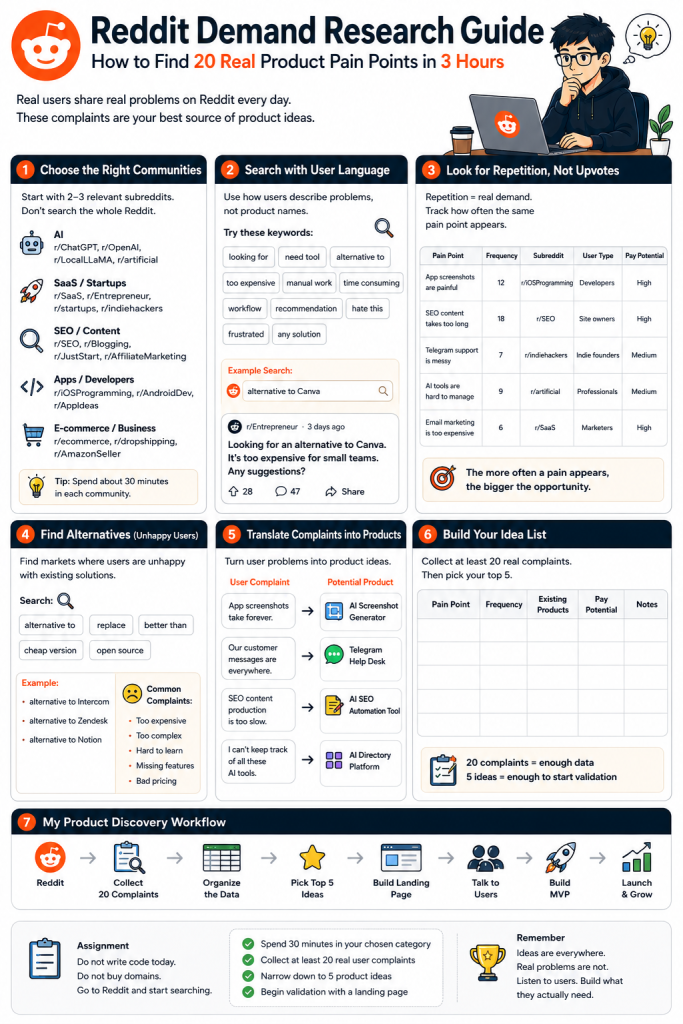
If you want to build products people actually pay for, you need to stop guessing and start listening. Reddit is one of the best places to do that.
Every day, millions of users complain, ask for alternatives, search for tools, and describe broken workflows. For indie hackers, these posts are not just discussions.
They are product opportunities.
This guide will show you how to use Reddit to discover real demand and collect at least twenty usable pain points within a few hours.
Why Reddit Is So Good for Finding Product Ideas
Most platforms are designed for showing results.
People share wins, traffic screenshots, launches, and revenue updates.
Reddit is different.
Users openly talk about problems.
You will constantly see posts like:
“Is there a better tool for this?”
“I hate this workflow.”
“This software is too expensive.”
“Why hasn’t anyone built this yet?”
Those posts are powerful because users have already done three things:
First, they admitted they have a problem.
Second, they started looking for solutions.
Third, they invested time explaining the issue.
At that point, they are often much closer to paying than most founders realize.
Step 1: Start With Communities, Not Global Search
Do not search Reddit randomly.
Begin with focused communities.
If you are interested in AI products, explore:
- r/ChatGPT
- r/OpenAI
- r/LocalLLaMA
- r/artificial
If you want SaaS opportunities:
- r/SaaS
- r/Entrepreneur
- r/startups
- r/indiehackers
- r/SideProject
For SEO and content products:
- r/SEO
- r/Blogging
- r/JustStart
- r/AffiliateMarketing
For apps and mobile tools:
- r/iOSProgramming
- r/AndroidDev
- r/AppIdeas
Choose only three communities at first.
Spend around thirty minutes in each one.
That alone is enough to uncover a surprising number of ideas.
Step 2: Search Using User Language
Most founders search product names.
That is a mistake.
Search how users describe problems.
Use phrases like:
looking for
need tool
alternative to
too expensive
manual work
time consuming
recommendation
workflow
frustrated
hate this
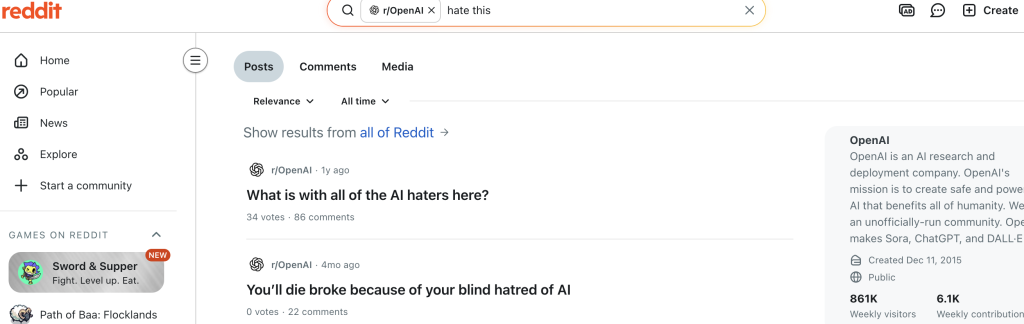
For example:
Search:
alternative to Canva
You may discover complaints about pricing, missing features, subscription fatigue, or complicated workflows.
Search:
need screenshot tool
You will often find app developers struggling with screenshot generation, size adaptation, localization, and design work.
That is not just discussion.
That is market research.
Step 3: Ignore Upvotes and Look for Repetition
A common mistake is chasing popular posts.
High engagement does not always mean strong demand.
What matters more is repetition.
Imagine this pattern:
- Monday:Someone complains about SEO content production.
- Wednesday:Another user asks for an alternative.
- Next week:More people discuss the same issue.
- A month later:The topic appears again.
Now you have something interesting.
Repeated pain is usually more valuable than viral content.
Build a tracking sheet like this:
| Pain Point | Frequency | Community | User Type | Payment Potential |
|---|---|---|---|---|
| App screenshots are painful | 12 | iOS | Developers | High |
| SEO writing takes too long | 18 | SEO | Site owners | High |
| Telegram support is messy | 7 | IndieHackers | Store owners | Medium |
The more often a complaint appears, the more real the opportunity becomes.
Step 4: Look for Alternatives, Not Empty Markets
Many founders search for markets with no competition.
That sounds smart, but often means there is no demand.
A better strategy is finding markets where users are unhappy.
Search:
alternative to
replace
better than
cheap version
open source
Examples:
alternative to Intercom
alternative to Zendesk
alternative to Notion
You will discover recurring complaints:
- Too expensive.
- Too many features.
- Hard to learn.
- Bad pricing.
- Slow workflows.
Your goal is not reinventing everything.
Your goal is:
- Make it simpler.
- Make it cheaper.
- Make it faster.
- Or make it specialized.
That is where many successful indie products come from.
Step 5: Translate Complaints Into Products
Collecting complaints is only half the work.
Now you must translate them.
Users speak in problems.
Founders think in products.
User says:“App screenshots take forever.”
Possible product:AI Screenshot Generator
User says:“Our customer messages are everywhere.”
Possible product:Telegram Help Desk
User says:“SEO content production is too slow.”
Possible product:AI SEO Automation Tool
User says:“I cannot keep track of all these AI tools.”
Possible product:AI Directory Platform
One complaint can become one product.
Ten complaints become a niche.
Twenty complaints become a roadmap.
My Current Product Discovery Workflow
I used to work like this:
Idea
↓
Build
↓
Launch
↓
No users
↓
Project dies
Now the workflow looks different:
↓
Collect 20 complaints
↓
Organize data
↓
Choose top five ideas
↓
Build a landing page
↓
Talk to users
↓
Create MVP
↓
Launch
The order changed.
Results changed too.
Before, I trusted inspiration.
Now, I trust users.
Practical Assignment
Do not write code today.
Do not buy domains.
Open Reddit.
Pick one category:
- AI
- SEO
- SaaS
- Telegram
- Apps
Spend thirty minutes searching.
Create a table like this:
| User Complaint | Community | Frequency | Existing Products | Payment Potential |
|---|---|---|---|---|
Your goal:
Collect at least 20 real complaints.
Then narrow them into 5 product opportunities.
That is enough to start validation.
Next lesson:
Product Hunt Research Guide: How to Discover Small Products Worth Building.
We will cover:
How to analyze launches.
How to spot profitable ideas.
And how to avoid crowded markets.
Be First to Comment