


In recent years, more and more people have started side hustles, SaaS, AI products, and independent websites. Many people believe that as long as they have technical skills, can write code, can design web pages, and have a little execution ability, they can definitely create a product.
But reality is often not like that.
The outcome of many projects is actually determined from the moment they begin.
Some people spend three months developing a product, only to find no users after it goes live; others stay up all night writing code, completing dozens of features, only to discover that nobody uses them; still others have worked on five or six projects in a row, each of which failed because it was “finished as soon as it went live.”
Many people attribute the reasons to insufficient traffic, poor marketing skills, incorrect technology selection, or even doubt their own abilities.
In reality, most entrepreneurs fail for only one reason:
The first step was wrong.
For most people, the entrepreneurial process is essentially about “creating a work of art.”
Many programmers start their own businesses, and the process is almost identical.
An idea suddenly popped into my head:
“AI is all the rage, so I’ll make an AI tool.”
Let’s begin:
Register a domain name, buy a server, design a logo, set up a database, build a login system, accept payments, write the backend code, and optimize the pages.
A month later, the product was finally launched.
The result is that the backend is opened:
- 0 users.
- 0 income.
- 0 feedback.
The project eventually ended up on GitHub and was never opened again.
This situation is all too common.
Because what everyone is doing is not starting a business, but creating a technological work.
What they were thinking about was:
- “This feature is cool.”
- “This technology can achieve it.”
- “If others can do it, I can do it too.”
But the real business problem is never:
What can I do?
Instead:
Why are users willing to pay?
The first step in starting a business is not making a product, but finding the demand.
When many people hear about starting a business, their first reaction is:
What am I supposed to do?
Actually, the question was wrong from the start.
The real question should be:
Who is experiencing problems?
The essence of entrepreneurship is not creating demand, but discovering demand.
Whether a project survives usually depends on three factors:
First, are there any real pain points?
Second, does this problem occur frequently?
Third, are users willing to spend money to solve this problem?
All three conditions are indispensable.
For example.
Many people, seeing the explosion of AI, want to do AI writing.
However, there are already many similar products on the market, the competition is fierce, the user switching cost is extremely low, and the customer acquisition cost is getting higher and higher.
Another type of person will first go to the community to observe.
They discovered:
Many developers complain that App Store screenshots are too difficult to create and that manually adjusting the size is too troublesome.
So I created a screenshot generation tool.
The functions are not complex and the technical difficulty is not high, but because the problems are real and users already exist, it is easier to make money.
They’re both making products.
One person is trying to guess what the user needs.
Another person is addressing issues that users have already complained about.
The results will naturally be different.
The biggest trap: the need for fantasy
Many projects don’t fail during the development phase, but rather during the requirements phase.
Because what entrepreneurs are doing is not real demand, but imagined demand.
What is the concept of fantasy needs?
for example:
- “I think everyone should need this.”
- “This feature looks amazing.”
- “AI can do it, so it’s worth doing.”
- “If others make money, I’ll just copy them.”
These are all dangerous.
Genuine needs usually have clear signals.
- The user is already searching.
- Users are already complaining.
- The user has already spent money.
- Users are looking for alternatives.
If you go to Reddit, Product Hunt, Twitter, forums, QQ groups, and WeChat groups, you’ll find a lot of similar comments:
- “Are there any tools that can solve this problem?”
- Does anyone know of an alternative?
- “I am willing to pay for it.”
“This software is too expensive, is there a cheaper alternative?”
These are the places where real demand gathers.
Instead of one’s own brain.
The biggest cost of starting a business is not losing money, but going in the wrong direction.
Many people believe that the biggest loss from a failed business is losing money.
Actually, no.
What’s truly expensive is:
Even when you’re going in the wrong direction, you still keep trying.
Some people spend six months developing a product.
Someone wrote 100,000 lines of code.
Some people create dozens of functions.
Finally, it was discovered that:
Nobody needs it.
When the direction is wrong, the stronger the execution, the greater the loss.
There’s nothing wrong with putting in the effort.
But if you’re going in the wrong direction, your efforts will only amplify the mistakes.
Many independent developers don’t fail because they don’t work hard enough, but because they work too hard.
Because from day one, they were heading in the wrong direction.
I later changed my approach to projects.
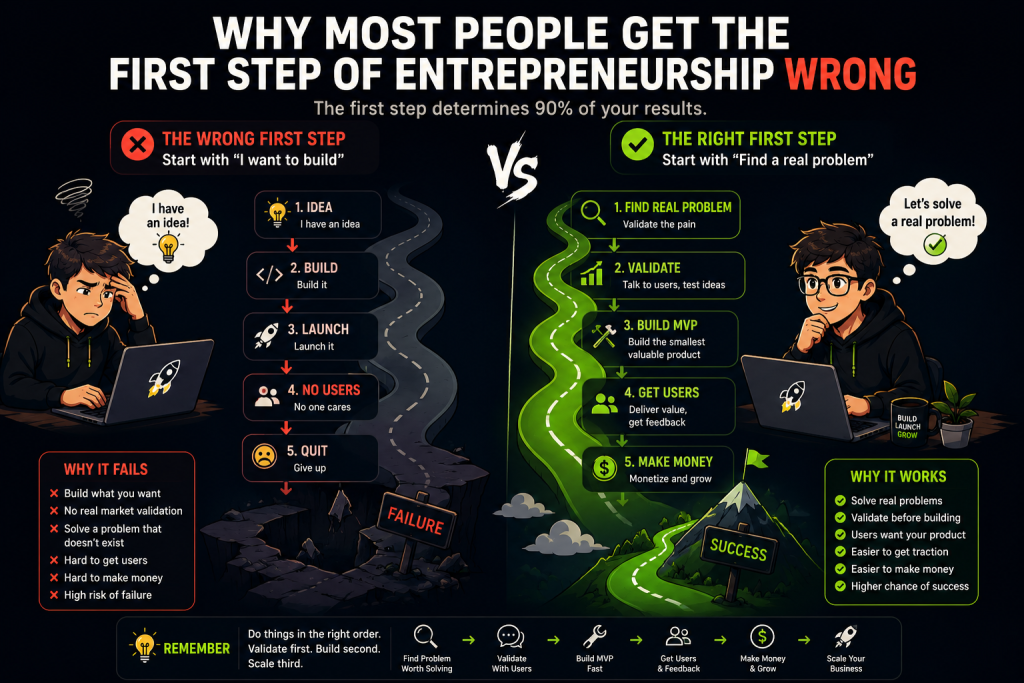
My previous project workflow was:
I’ve got an idea.
- Development begins.
- Product launched.
- Waiting for users.
- No data available.
- The project has ended.
Later I discovered that there were major problems with this process.
My current order is:
- First, identify the needs.
- Re-verify the requirements.
- Create a Landing Page.
- Receive feedback.
- Find seed users.
- It has been confirmed that someone is willing to pay.
- Development only began last.
The biggest change is:
I used to write the code first.
Let’s verify the money first.
Because code can be rewritten.
Time cannot be turned back.
How to find truly worthwhile projects?
If you are ready to start making a product now, you can try the following methods.
First, open Reddit.
Search these keywords:
- Looking for tool
- Software needed
- alternative to
- recommendation
- pain point
Record the issues that users complain about most.
Don’t rush into doing it.
First, collect them.
Identify at least twenty pain points.
The second step is to open Product Hunt.
Don’t focus on the top spot on the leaderboard.
Look at the smaller products ranked between 10th and 50th.
Key observations:
- What problems do they solve?
- What is the payment method?
- What users are interested in in their comments?
Third, open Google Trends.
Search for track keywords.
Observe the trend.
If the price has been declining continuously, it is not recommended to enter the market.
If it shows long-term growth, further research is warranted.
Finally, organize everything into a table:
Project name, user pain points, target audience, payment method, and development difficulty.
After accumulating twenty projects, then start making a selection.
Don’t act impulsively just because you see an idea.
That would have a very high failure rate.
The real order of starting a business should be reversed.
Many people think that starting a business is:
- First, develop the product.
- Find more users.
- Finally, I’ll figure out a way to make money.
Actually, it should be the other way around.
First, find the users.
- Confirm the issue.
- Verify payment.
- Make another product.
- Finally, expand the scale.
Starting a business is never a game of speed.
It’s a game of direction.
No matter how fast you run, if you’re going in the wrong direction, you’ll only get to the finish line faster.
So before starting the next project, ask yourself this question:
Who is suffering because of this problem?
If you can’t find the answer.
Don’t write any code yet.
In the next article, we’ll continue our discussion: “How to Determine if a Need is a Genuine Need,” which will focus on: how to distinguish between genuine and false needs; how to verify whether users are willing to pay; and how to complete a low-cost project verification within 7 days.
Be First to Comment