



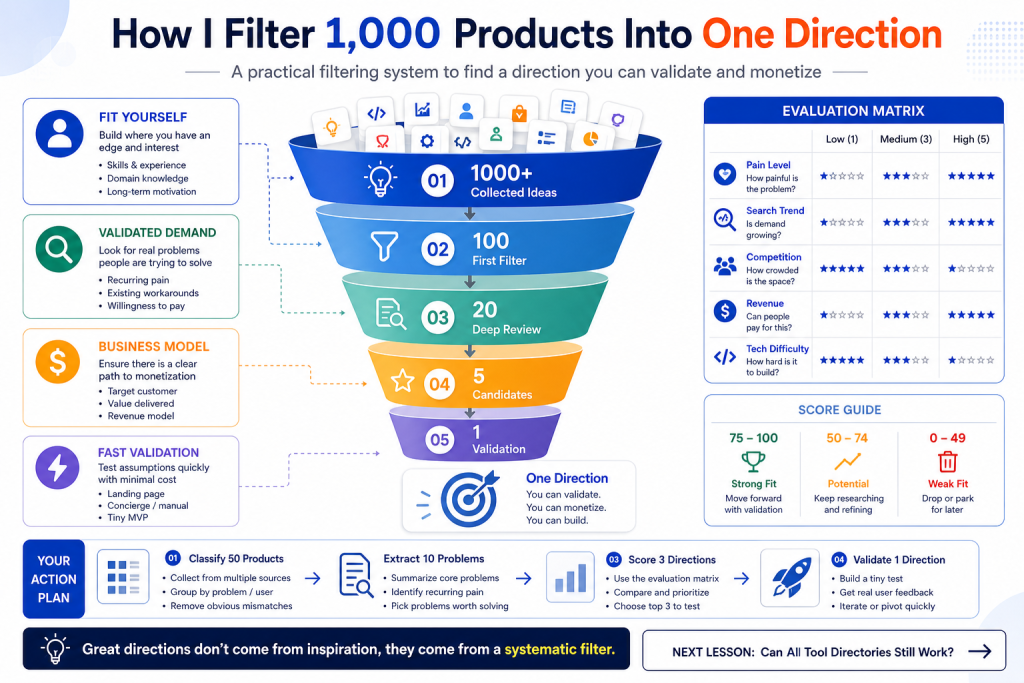
When people look for startup ideas, they often assume they lack inspiration. So they start collecting products aggressively. They browse Product Hunt, scroll Reddit, read indie revenue screenshots, and save every AI tool, Chrome extension, template site, SaaS, and directory they can find. The more they see, the more opportunities seem to exist. The more opportunities seem to exist, the harder it becomes to choose one.
This is one of the most common traps in finding a direction. You think you are researching the market, but you may simply be consuming information. More information does not automatically create better judgment. It can create more anxiety. Every product can tell a convincing story. Every category has a success case. Every market has someone saying it is still early and someone saying it is already dead. In the end, you do not get a direction. You get a pile of conflicting possibilities.
I later realized that the purpose of studying 1,000 products is not to copy one of them, and it is not to wait for a magical idea to appear. The useful approach is to treat those 1,000 products as raw data, then compress them through a repeatable filtering system into a few hypotheses worth validating. A direction is not discovered by staring at products. It is filtered out. You are not asking which product looks the hottest. You are asking which group of people repeatedly faces a costly problem, and whether you can validate it through a small entry point.
First Remove Projects You Should Not Build
When you look at many products, your first job is not deep analysis. Your first job is elimination. Many beginners take every product too seriously. If a product is growing, they study the feature list. If a product makes money, they analyze the business model. If the landing page looks good, they want to copy the design. After a whole day, they have studied only a few products and feel even more confused.
The rough filtering stage should work in the opposite way. You need to accept that most opportunities are not yours. A project may be good and still be a poor fit for your current situation. Directions that require supply chain resources, offline fulfillment, heavy enterprise sales, large support teams, complicated compliance, constant content production, or manual delivery may make money, but they are often too heavy for a first solo project.
I usually use five questions to eliminate quickly. Does it solve a specific problem? Can users clearly feel the problem? Are existing solutions painful? Is there any chance users would pay? Can I build a small version? If three of these answers are weak, I stop researching the product. Rough filtering is not about finding the final answer. It is about protecting your attention.
For example, many products may all belong to the AI category, but they are not the same opportunity. Customer support bots may have strong willingness to pay, but sales and integration can be heavy. Generic writing tools have broad demand, but competition is intense and differentiation is difficult. PDF summarizers are lightweight and easier to validate, but the ceiling may be limited. Resume tools have a clear scenario, but demand can be seasonal. You should not ask only whether AI products still work. You should ask whether this specific shape fits what you can build now.
Classify by User Problems, Not Product Types
Many people classify products by shape: app, extension, SaaS, directory, template, bot. That is not wrong, but it is not enough for finding a direction. Product shape is only the container. The real commercial value comes from the user problem underneath.
I prefer to break every product into three parts: who it serves, what problem it solves, and what cost that problem creates. Once you use these three dimensions, many different-looking products suddenly become similar. A Chrome extension, a Notion template, a small SaaS, and an automation script may all solve the same underlying problem: helping a specific user shorten a repetitive task, reduce errors, or deliver faster.
For example, imagine you see many tools for Shopify sellers: product image generation, product description optimization, review analysis, competitor monitoring, SEO title generation, and ad creative generation. On the surface, they are different tools. Underneath, the demand pattern is consistent: sellers need to produce content faster, improve conversion, and complete operations at a lower cost. The useful note is not “another AI product photo tool.” The useful note is “Shopify sellers have continuous pressure around content and conversion.”
When you shift from product shape to user problem, the direction becomes clearer. You stop being led by how the product looks and start asking better questions. What does this user repeat every day? What affects their revenue? What clumsy method do they use now? Have they paid for alternatives? Which part of the workflow is still underserved?
Look for Repeated Demand, Not Isolated Inspiration
A hot product does not mean you should build something similar. A new product does not automatically mean a new opportunity. What matters is repeated demand. If you keep seeing the same problem across different platforms, products, and user discussions, it is no longer just an idea. It may be a demand signal.
Repeated demand usually appears in a few forms. The same user group complains about the same problem again and again, such as indie developers discussing SEO, payments, cold starts, monitoring, and email deliverability. Different products slice different parts of the same workflow, such as ideation, generation, publishing, distribution, and review. Users also create many alternatives, such as templates, scripts, outsourcing, manual services, spreadsheets, courses, or consulting.
This repetition matters because it suggests the problem may not exist only in your imagination. Many failed products start from an interesting feature but never find a stable user group. They notice one complaint but not a recurring cost. They see one product example but not the market structure behind it. Directions do not usually grow from one isolated product. They grow from several products pointing toward the same user struggle.
So when I study products, I record repetition carefully. If a problem appears once, it goes into the observation bucket. If it appears five or ten times, and different teams are solving it in different ways, I promote it into a candidate direction. Many good directions are not mysterious. The market has repeated the signal many times. Most people simply do not record it systematically.
Score Each Direction With Five Dimensions
Once you have many candidate directions, you should not choose by feeling. Feeling is easily distorted by trends, beautiful landing pages, revenue screenshots, and personal preference. A direction that feels exciting may not be suitable. A direction that looks boring may have strong business potential. At this stage, judgment needs to be written down.
I score each direction across five dimensions: pain intensity, willingness to pay, acquisition clarity, implementation cost, and competitive pressure. Each dimension gets a score from 1 to 5. The goal is not perfect accuracy. The goal is to force vague excitement into concrete reasoning. Pain intensity asks whether users are repeatedly bothered by the problem. Willingness to pay asks whether the problem connects to making money, saving money, saving time, or reducing risk. Acquisition clarity asks whether you can find users. Implementation cost asks whether you can build a small version. Competitive pressure asks whether existing players have already blocked the entrance.
One important point: the total score is not the only answer. A direction with strong pain and strong payment but high implementation cost may need to start as a manual service. A direction with easy acquisition and simple implementation but weak payment may work better as a traffic asset than as the main product. A direction with strong competition may still be possible if you can focus on a smaller user group, narrower scenario, or more specific workflow.
The value of scoring is not mathematical precision. It helps you stop choosing based on what you personally like. You may discover that some ideas are interesting to you but carry little user cost. Some directions look unsexy but have clear payment signals. Some opportunities may be worth doing later but are not suitable as the first project. A spreadsheet will not build the business for you, but it can reduce self-deception.
Keep Only Small Entry Points You Can Validate in 7 Days
At the end of filtering, the direction still cannot be too large. Many people finish their research with a grand conclusion: build an AI office platform, a global growth tool, an indie developer community, or an automation system for small businesses. These sound like directions, but they are still too vague because you cannot validate them immediately.
A usable direction must be compressed into a small entry point: one specific user group, one specific scenario, one specific problem, and one validation action you can complete within seven days. Do not say “AI marketing tool.” Say “a tool that helps small Shopify sellers generate SEO product descriptions in bulk.” Do not say “tools for indie developers.” Say “a tool that helps indie developers organize Product Hunt competitor data.” Do not say “content creator platform.” Say “a tool that turns YouTube videos into publishable blog drafts.”
The validation action does not have to be a full product. It can be a landing page, a form, a test article, a manual service, a Notion template, a cold email, a small script, or even a paid manual delivery. If real users leave emails, reply with details, book a trial, ask specific questions, or pay, you have a stronger signal than anything you can get from building quietly for weeks.
My final question is simple: can this direction get market feedback within seven days? If you must develop for three months before knowing whether anyone wants it, the direction is probably too heavy for an early project. A good direction is not the one that looks most complete at the beginning. It is the one that can be tested, adjusted, and brought close to real users quickly.
If I Started With 1,000 Products, I Would Do This
First, I would spend one day browsing quickly and removing products that clearly do not fit me, keeping only 10% to 20%. At this stage, I would not do deep research or write long analysis. I would only record the user, problem, product shape, and one sentence of judgment.
Second, I would reclassify the remaining products by user problem instead of industry or technology. The goal is to see who is paying a cost for what problem, not what AI technique the product uses.
Third, I would look for repeated signals. Which user groups appear again and again? Which problems repeat? Which alternatives repeat? Which products look different but solve the same underlying cost?
Fourth, I would score the candidate directions. I would not only ask whether I like the idea or whether someone else made money. I would look at pain, payment, acquisition, cost, and competition together.
Fifth, I would compress the top three directions into seven-day validation actions. I would not start by building a complete system. I would test whether users respond through the lightest possible method. A direction is not finalized inside a spreadsheet. It becomes clearer through real feedback.
Summary
Filtering a direction from 1,000 products is not about seeing more than everyone else. It is about making better tradeoffs. First remove opportunities that do not fit you. Then look past product shapes and identify user problems. Then use repeated signals to find demand clues. Then judge business potential through payment and acquisition. Finally, compress the direction into a small entry point that can be validated quickly.
For an indie builder, the most valuable resources are not ideas. They are time and attention. Studying products should not make your bookmark folder heavier. It should make your judgment sharper. You do not need to find a perfect answer from 1,000 products. You only need to find one hypothesis worth validating for seven days. If that hypothesis brings you closer to real users, reveals payment signals earlier, and helps you eliminate weak directions faster, then those 1,000 products have done their job.
Homework
- Find 50 products you recently saved or noticed, and sort them within one hour into three groups: clearly unsuitable, worth observing, and worth deeper research.
- Pick 10 products from the deeper research group and rewrite each one as: who it serves, what problem it solves, and what cost the problem creates.
- Identify the 3 most repeated user problems, then score each on pain intensity, willingness to pay, acquisition clarity, implementation cost, and competitive pressure.
- Choose 1 direction and compress it into a validation action you can complete within 7 days.
Next Lesson
Can AI Tool Directories Still Work: where the new opportunities are after the age of broad directories.
Be First to Comment