



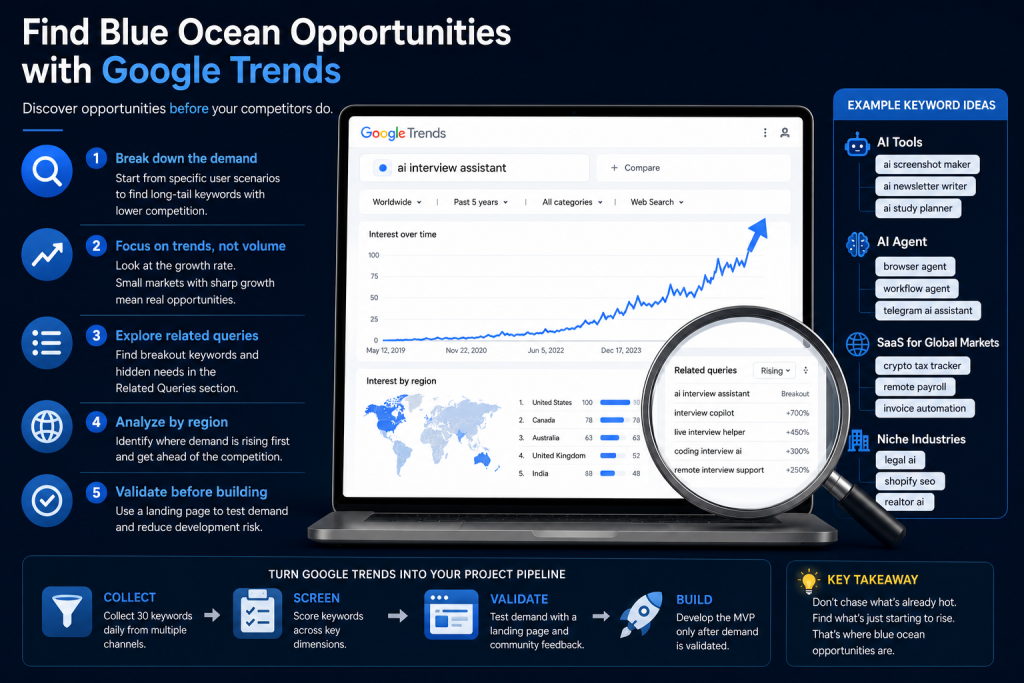
When most independent developers look for projects, their first instinct is to look for inspiration on Product Hunt, Reddit, X (Twitter), or AI tool rankings. But these places have one thing in common: by the time you see them, it’s often too late.
If a project makes it to the Product Hunt homepage, it means it’s already been developed; if a tool goes viral on Reddit, it means someone has already validated the market; if you try to jump on the bandwagon, you’ll usually only be entering a red ocean of competition.
What’s truly worth studying isn’t “what’s hot,” but rather: what’s slowly gaining popularity but hasn’t yet attracted the attention of many developers.
Google Trends is precisely the tool for discovering such opportunities.
Why is Google Trends better than Product Hunt for finding blue ocean markets?
Many people use Google Trends as a website to “watch the popularity curve,” entering keywords to see if it goes up or down, and then stopping.
In reality, its true value lies not in predicting trends, but in anticipating changes in demand.
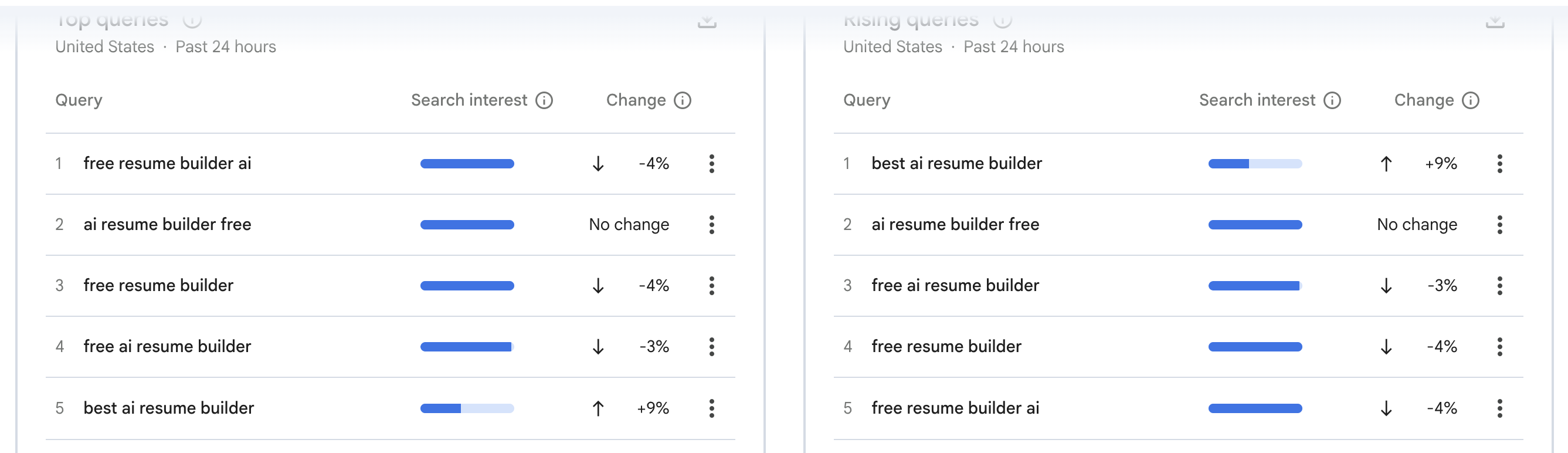
For example. Suppose you open Google Trends today and search:
- AI Resume Builder
- AI Interview
- AI Mock Interview
- Remote Interview Tool
You’ll find that some keywords may not have a high overall search volume, but their growth rate is very fast.
what does that mean?
This means the market is still small, but users are beginning to gather.
The biggest fear for independent development is not a small market, but rather:
Nobody is searching for it.
Because no one searches for it, no matter how well you do, you won’t get organic traffic.
If the market is small, it can be expanded slowly; if no one searches, it basically means there is no demand.
What Google Trends does is help you confirm things in advance:
Have users already started looking for this?
This step is more important than writing code.
Step 1: Don’t search for “broad keywords,” but break down your needs.
Many people make a mistake when using Google Trends for the first time.
enter:
- AI
- ChatGPT
- SaaS
- Agent
- Productivity
Then it was discovered that:
Wow, it’s so hot!
But these words have no meaning.
Because: the higher the search volume, the fiercer the competition. The real blue ocean is often hidden in the long tail.
For example, instead of searching for “AI” , search for:
- AI flashcard generator
- AI meeting notes
- AI study planner
- AI cover letter writer
- AI screenshot maker
- AI Etsy description
- Telegram customer support
- Crypto tax tracker
These keywords correspond to:
One function.
A user scenario.
It’s even close to becoming a product.
For example:
- “AI screenshot maker” likely refers directly to: App screenshot generator.
- “Telegram customer support” likely refers to a website customer service plugin.
- Crypto tax tracker may become a tax SaaS.
Many independently developed products emerge in this way.
It doesn’t start with the industry, but with the keywords.
Step 2: Analyze trends, not absolute search volume.
One of the biggest misconceptions about Google Trends:
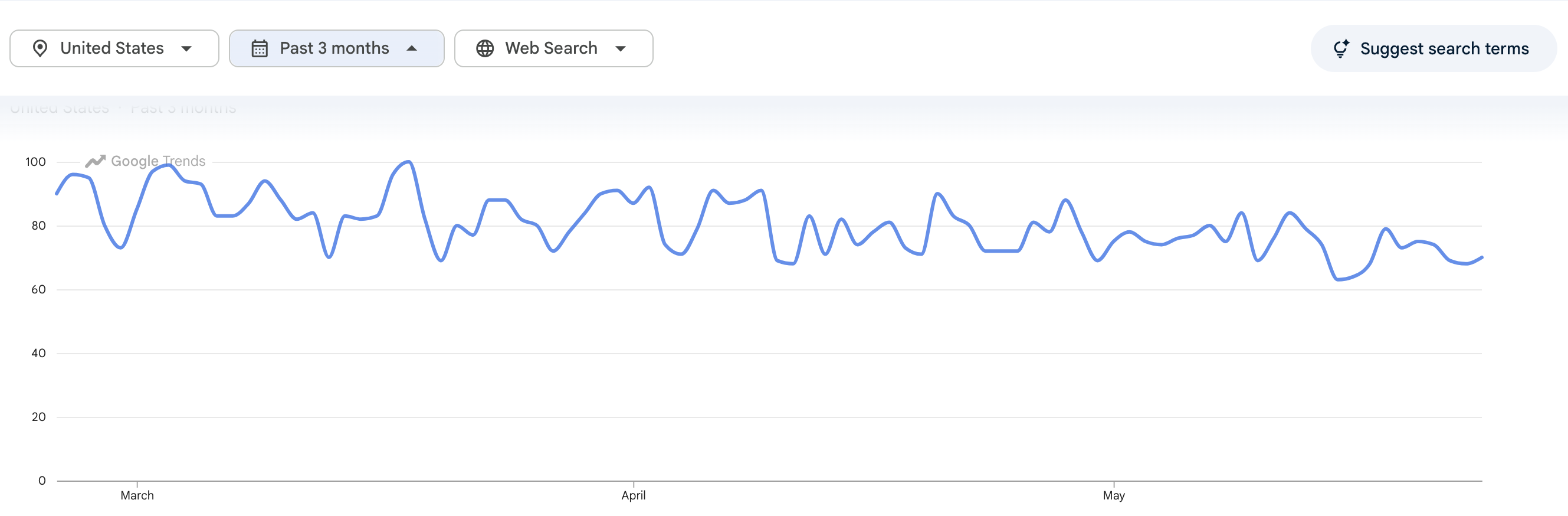
People like to look at numbers.
Actually, we should look at the slope.
for example:
Track A:
- Long-term 100
- Now 105
Growth: 5%
Track B:
- Long-term 5
- Now 30
Growth: 500%
Although track B is small, it is starting.
For independent developers:
A rising small market is more valuable than a stable large market.
because:
A large market means giants.
A small market means opportunity.
Especially suitable for:
- One-person company
- AI tools
- MicroSaaS
- Plug-in products
- SEO traffic site
- Automation tools
You’re not going to be the next ChatGPT.
What you are looking for is:
A year later, when others start competing, you’ve already secured your place in that field.
Step 3: Use Related Queries to uncover hidden requirements
Many people only look at the curve on the homepage.
The truly valuable items are the following:
Related Queries
This is often seen here:
“Breakout”
In other words, words that experience explosive growth.
For example.
If searching:
AI Interview
Possible occurrences:
- AI interview assistant
- interview copilot
- Live interview helper
- coding interview AI
- remote interview support
These are not ordinary keywords.
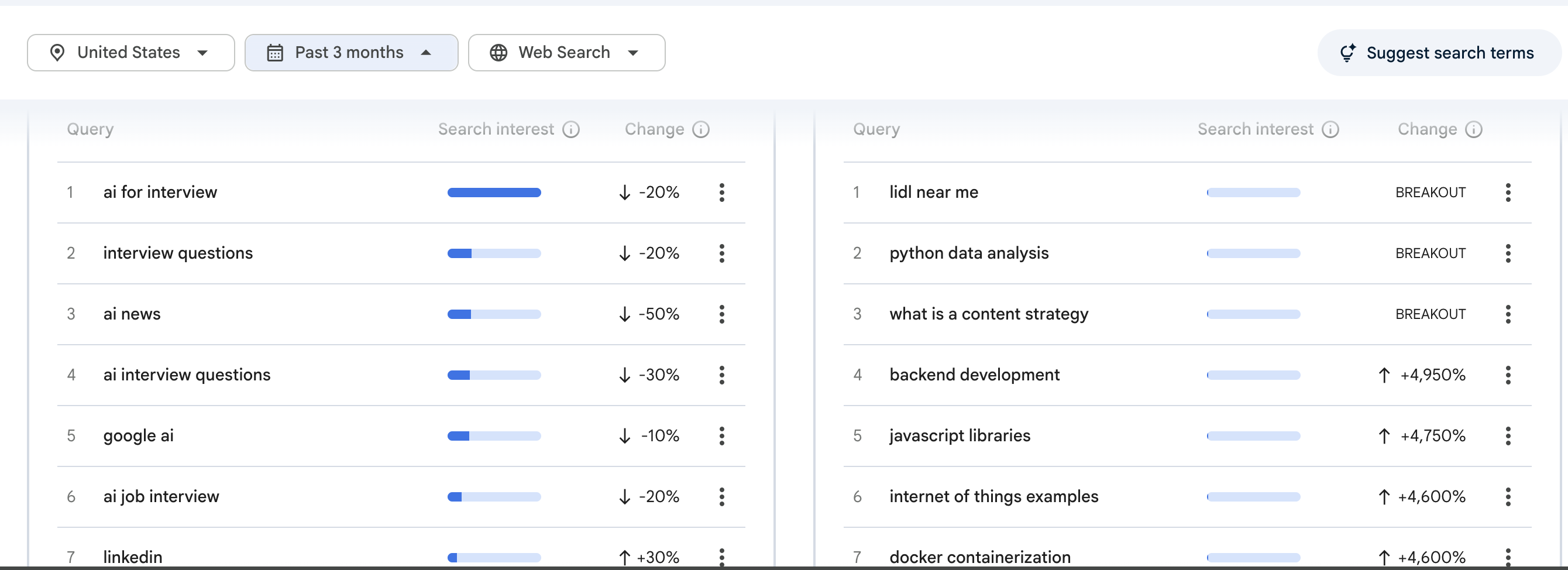
They are close:
Product Name.
You can even verify it directly:
- Search Product Hunt
- Check if the domain name has been registered.
- See SEO difficulty
- Check Reddit discussion volume
- Check if there are any paying users
if:
There’s been discussion about it.
Search volume increased.
Low competition.
That basically means we’ve entered the MVP stage.
Step 4: Regional data is more important than overall popularity.
Many independent developers overlook one problem:
Demand did not erupt simultaneously worldwide.
It often starts in a particular country.
For example:
Digital nomad tools:
It might heat up first:
- United States
- Canada
- Australia
Cross-border seller tools:
Possible focus:
- China
- Singapore
Encryption related:
Usually first:
- United Arab Emirates
- Turkey
If you find a certain word:
Prices in the US have started to rise.
Europe remained inactive.
Nobody in Asia is doing it.
That might be an opportunity.
Because you can plan ahead for content, SEO, and product pages.
By the time the market expands, the site will already have authority.
Step 5: Turn Google Trends into a project pipeline
Many people rely on intuition to find inspiration.
I was browsing Reddit today.
Watch Product Hunt tomorrow.
I’ll check Twitter the day after tomorrow.
It’s very inefficient.
It is recommended to establish a fixed process directly:
Phase 1: Collection
Record 30 keywords daily.
source:
- Google Trends
- Product Hunt
- App Store
- Chrome Extension
- AI Tool Directory
Phase Two: Screening
Score for each word:
| Dimension | Fraction |
|---|---|
| Search growth | 20 |
| SEO is easy | 20 |
| There are paid products | 20 |
| Independent development is possible | 20 |
| Automatable | 20 |
Total score: 100.
Those scoring above 70 will be placed under observation.
Scoring 80 points directly makes him the MVP.
Phase 3: Verification
Don’t start developing immediately.
First, create the Landing Page.
put:
- Function Introduction
- Email subscription
- Waitlist
- Pricing page
- Demo diagram
Then cast:
- Hacker News
- X
- Facebook Group
- SEO page
If no one leaves an email address.
This indicates that demand is insufficient.
If people start registering.
Write more code.
A set of Google Trends blue ocean keyword directions suitable for independent developers
AI Content Tools
- AI newsletter writer
- AI Reddit post generator
- AI SEO article builder
- AI screenshot creator
- AI thumbnail maker
AI Agent Tools
- browser agent
- workflow agent
- coding agent
- Telegram AI assistant
- desktop agent
Overseas SaaS
- invoice automation
- crypto accounting
- remote payroll
- tax helper
- affiliate tracking
Content traffic site
- startup stories
- Indie Hacker Interview
- remote jobs
- AI founders
- freelancer database
Vertical industries
- legal AI
- dentist CRM
- Etsy helper
- Shopify SEO
- realtor AI
These tracks may not be profitable immediately.
However, they meet three conditions:
- First, there is a search function.
- Second, the competition hasn’t completely exploded yet.
- Third, one person can do it.
This has exceeded most ideas in the market.
In conclusion: Don’t chase hot trends; chase “demand that has just begun to rise.”
The biggest misconception about independent development is always trying to find:
“The next big trend.”
In reality, by the time a trend emerges, it’s usually too late.
A better way is:
Go find those:
Searches have just started to rise.
Competition is not yet high.
Users started discussing.
The product is still very rough.
These are often the real blue oceans.
Google Trends doesn’t tell you what to do directly.
But it can tell you:
Where are users going?
The real money-making opportunities for independent developers usually lie in the very early stages of a user’s journey.
Homework for this lesson
Open Google Trends.
Choose a large track:
- AI
- SEO
- Automation
- SaaS
- Agent
- Content
Then break down at least 5 layers of keywords .
- Create a trend table: keywords, trend direction, level of competition, user type, payment method, and whether to enter the market.
- Finally, 5 growth directions were identified .
- Then select one blue ocean project to be tested.
Next lesson:
“How I sift through 1000 products to find truly worthwhile directions”
Be First to Comment