



Introduction
Over the past two years, AI tool directories became one of the most popular directions among indie builders. Directories, prompt marketplaces, agent lists, model indexes, AI product rankings, newsletters, and discovery sites appeared one after another. Many people saw others getting traffic, selling ads, running affiliate links, charging for listings, or building memberships. Naturally, they asked: can AI tool directories still work, or is it already too late?
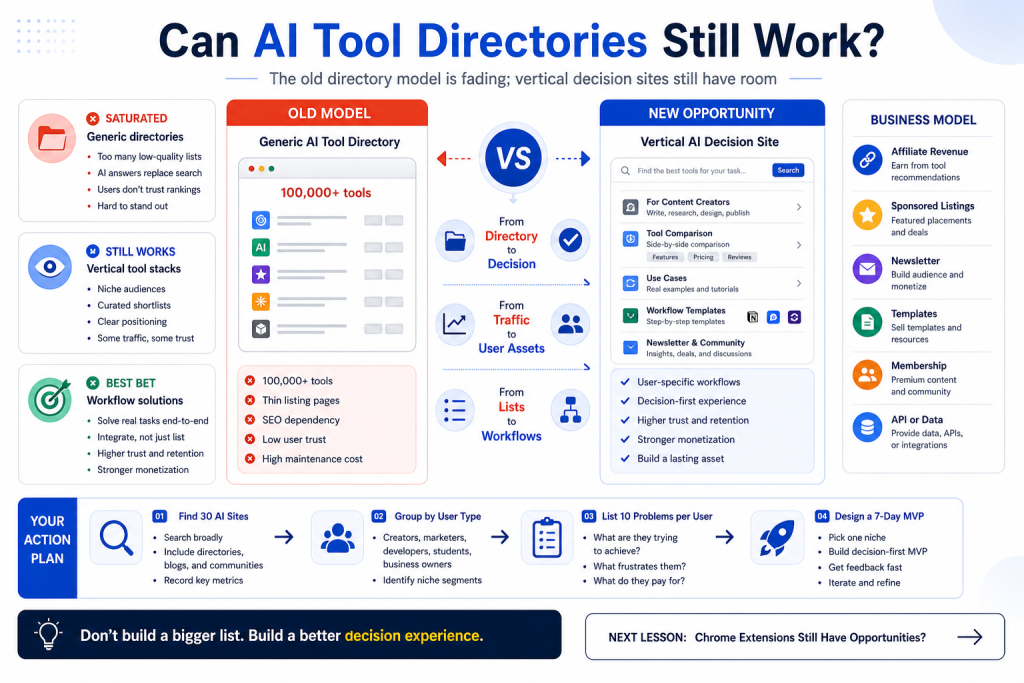
The answer is not as simple as yes or no. AI tool directories can still work, but the old “big and broad” directory model is getting much harder. The real opportunity is no longer another site that lists thousands of tools. It is a more vertical, denser, and more useful decision site for a specific user group. Users no longer need another generic list. They need help choosing the right tools for a real task.
The Listing Era Is Mostly Over
From 2023 to 2024, the biggest advantage of AI tool directories was information asymmetry. New AI products launched every day, and users did not know where to find them. Whoever built the directory first, categorized faster, and captured search traffic earlier could get attention. The model was simple: collect tools, write descriptions, create category pages, rank for long-tail keywords, and monetize with ads or affiliate links.
That stage is now mostly over. Users already know how to find AI tools. They search Google, ask ChatGPT or Perplexity, check Reddit, watch YouTube reviews, browse Product Hunt, and follow communities. A new site saying “50,000+ AI tools” is no longer impressive by itself. The value of raw collection has been diluted. When you build a generic AI directory today, you are not just competing with other indie builders. You are competing with search engines, AI answers, large platforms, old directories, and user fatigue.
The problem is not that AI tools are no longer useful. The problem is that tool lists are too easy to copy. Name, logo, category, short description, pricing, and official link do not create enough trust. Users want to know which tool fits their scenario, which one is worth paying for, which one is overhyped, and which combination works together. A directory that only lists tools becomes a database. A directory that helps users decide becomes a product.
The Opportunity Is Vertical Decision Sites
Do not ask whether AI tool directories can still work. Ask which users still suffer from information overload. Shopify sellers, for example, constantly search for AI product photo tools, SEO description generators, ad creative tools, pricing analysis, competitor monitoring, and review analysis. A generic AI directory is weak for them. But an “AI tools for Shopify sellers” site can be valuable because every page maps to a real business task.
Indie developers are another strong group. They care about coding agents, MCP, Claude skills, Cursor rules, prompt workflows, automation scripts, SEO tools, Product Hunt launches, and AI coding. A generic AI tool directory competes with everyone. An “AI stack for indie hackers” site can become a focused media and workflow hub. It can include weekly tool discovery, workflows, prompts, launch templates, revenue breakdowns, and real case studies.
Cross-border sellers, teachers, creators, lawyers, designers, and freelancers all have different AI tool needs. The smaller the user group, the easier it is to build trust. Vertical does not mean small in value. It means the site knows exactly who it serves. Users stay longer when they feel the site understands their work.
The Second Wave Is Recommendation and Workflow
Many people think a directory has only one form: collect, categorize, search, and redirect. That is the old model. The new model adds intelligence and workflow. Instead of asking users to browse hundreds of tools, the site can ask what they are trying to do and recommend a tool stack. If a user says, “I want to build a Shopify pet store,” the site can recommend logo tools, banner tools, product photo tools, SEO tools, email tools, and ad generators in the right order.
This is no longer just a directory. It becomes an AI guide. If an indie developer says, “I want to build an agent product,” the system can generate a tech stack, skill market references, launch channels, SEO tools, Product Hunt checklist, and Reddit communities. That is closer to an AI search and workflow engine. The value is much higher than a static list because it reduces decision cost.
The commercial model also changes. A directory does not have to make money only from listing fees or ads. It can become a traffic entry that captures emails, builds a newsletter, sells templates, recommends tools through affiliate links, offers memberships, provides API access, builds data products, or launches its own tools. The site is no longer the whole business. It becomes the first layer of a product matrix.
What I Would Avoid Today
I would avoid building a huge generic AI tool directory. A site with 100,000 tools sounds impressive, but the operating cost is high. You need crawling, deduplication, categorization, updating, indexing, SEO, and content quality control. Search engines are stricter with low-value aggregation pages. If every page is thin and similar, more pages may create more problems instead of more traffic.
I would also avoid standalone prompt marketplaces unless they are tied to workflows, agents, or industry scenarios. Prompts alone are becoming free materials. Users do not want to buy isolated prompt text as much as they want complete results. A prompt plus workflow, a prompt plus template, or a prompt plus industry use case is more defensible.
The third type I would avoid is an AI discovery site with no clear user group. If the site posts a writing tool today, an image tool tomorrow, and a developer framework the next day, nobody knows whether it is for them. The most dangerous thing about a directory is not lack of content. It is lack of audience.
If I Started Today, I Would Cut Like This
I would not start with “AI tool directory.” I would start with a user group. First layer: Shopify sellers, indie hackers, cross-border teams, freelancers, creators, teachers, or marketers. Second layer: their problems, such as finding tools, workflows, prompts, case studies, templates, and channels. Third layer: content and product formats, such as tool libraries, tutorials, rankings, templates, newsletters, and community. Fourth layer: monetization, such as affiliate links, memberships, listing fees, sponsorships, API, consulting, and data products.
This kind of site is no longer just a navigation page. It becomes vertical AI media plus data site plus tool site. Its lifecycle is longer because it owns judgment, audience, and workflow, not just links.
Summary
AI tool directories are not dead. What ended is the era of “the more tools you list, the more valuable you are.” The new opportunity is moving from broad to deep, from tool directory to scenario solution, from traffic site to user asset, and from listing to recommendation, AI search, and workflow. If you want to build an AI tool site today, do not ask whether the category still works. Ask which people still spend too much time looking for AI tools and are not yet served well. That is where the opportunity lives.
Homework
- Find 30 AI tool sites and group them by user type instead of feature category.
- Identify repeated user groups such as sellers, developers, teachers, and creators.
- List 10 high-frequency problems for each user group.
- Choose 1 problem and design a minimal AI tool site MVP that can launch within 7 days.
Be First to Comment