


For product developers, the thing they fear most isn’t competition.
It’s not that we lack the technology.
Thanks for reading Harries’s Substack! Subscribe for free to receive new posts and support my work.
What’s truly terrifying is:
You think there’s a demand, but actually nobody needs it.
Many independent developers fail in almost the same way:
I saw a direction.
I think it’s good.
Start writing code.
I worked on it for a month.
Launched.
Nobody uses it.
The project stopped updating three months later.
Then we can conclude:
“The market is too volatile.”
But most of the time, it’s not a market roll.
Instead, from day one, they were creating fake demand.
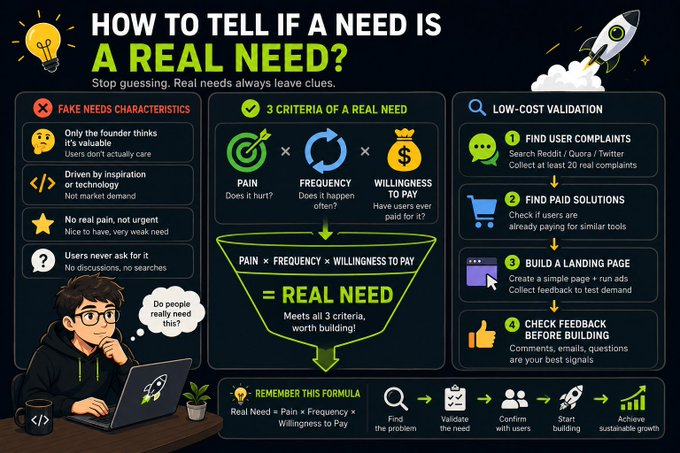
What is false demand?
False demands share a common characteristic:
Only entrepreneurs find it valuable.
Users don’t care.
For example, we often see scenarios like this:
Some people say:
“AI is all the rage, so I’m going to make an AI tool.”
Some people say:
“This feature is cool, someone should buy it.”
Others said:
“If others make money, I’ll copy it.”
These are not requirements.
This is:
inspiration.
interest.
Technological impulse.
Rather than the market.
Real needs can’t be guessed.
It will definitely leave a trace.
Genuine needs are always accompanied by a sense of “pain”.
To determine whether a demand is genuine, the first thing to do is not to look at the market size.
Instead, look at:
Does the user feel pain?
For example.
If someone says:
“It would be great if there was a tool to automatically organize my desktop files.”
This may be a demand.
But it’s not necessarily strong.
Because even if users don’t solve the problem, they can still continue to live their lives.
Let’s look at another one:
“Resizing screenshots on the App Store is too troublesome; I have to redo it every time I upload an app.”
The pain was significantly stronger.
Because it occurs frequently.
Wasting time.
It affects my work.
Users have started to complain.
They are even willing to pay money.
The stronger the pain, the more real the need.
The first criterion for judging demand: Are users already complaining?
Many people, when looking for needs, only look at:
Product rankings.
Financing news.
AI is a hot topic.
But real opportunities are often hidden in complaints.
Open Reddit.
search:
- looking for alternative
- Need tool
- any recommendation
- Hate this workflow
- pain point
You will find a lot of content:
- “Are there any alternatives to XX?”
- “This software is too expensive.”
- Why hasn’t anyone implemented this feature?
- Who can solve this problem?
These are not inspirations.
This is something the user is telling you proactively:
There is an opportunity here.
If no one is discussing a particular direction.
No one complained.
No one is searching.
There’s a high chance no one will pay.
The second criterion: Has the user spent any money?
Many demands seem very strong.
But the user never paid any fees.
You have to be very careful in this direction.
The real demand usually already exists in transactions.
for example:
- SEO tools.
- Screenshot tool.
- Customer service system.
- Email marketing.
- Alliance platform.
Users are already buying.
only:
- expensive.
- complex.
- Difficult to use.
What you’re doing is optimization.
It’s not the education market.
in turn.
If the user has never spent even $1.
You may need to educate the entire market first.
This is usually very difficult.
Therefore, when evaluating projects now, I first ask:
Has anyone paid to solve this problem?
If the answer is no.
I will be very careful.
The third criterion: Does the problem occur frequently?
Some of the demands are genuine.
But it’s still not worth doing.
Because it happens too infrequently.
for example:
- Some people change their profile picture once a year.
- Some people make a resume every three months.
- Some people change their website logo every six months.
These needs exist.
But the frequency is too low.
Users will not pay in the long term.
And the following:
- SEO content.
- Customer service replied.
- Screenshot generated.
- Marketing copywriting.
- Data analysis.
It happens every day.
High frequency means:
Continue to use.
Continue to pay.
Continued growth.
The higher the frequency, the greater the value.
A simple formula: Genuine Needs = Pain Points × High Frequency × Paid Content
I now evaluate projects based on only three dimensions.
- First: Does the user experience pain?
- Second: Does the problem occur frequently?
- Third: Does the user have a payment record?
All three conditions are met.
You can continue.
Both conditions are met.
cautious.
Only one condition is met.
Basically, we’ve given up.
For example.
AI screenshot tool
Pain point: High. Frequency: High. Payment: Yes.
Conclusion: It’s worth doing.
AI Poetry Writing Tool
Pain point: Low. Frequency: Low. Monetary interest: Weak.
Conclusion: Dangerous.
How to validate requirements at low cost
Many people start writing code as soon as they think about verification.
Actually, it’s completely unnecessary.
The simplest method:
Create a Landing Page.
put:
- Product introduction.
- Core values.
- price.
Button:
- Join now.
- Get started.
- Schedule a trial session.
Then cast:
- Reddit.
- Twitter.
- Quora.
- WeChat group.
- Independently developed community.
If no one orders.
No one left an email address.
Nobody asked about the price.
Don’t develop it.
Keep searching.
If anyone leaves a comment:
When will it be released?
“Can it open sooner?”
“Willing to pay.”
Then let’s continue.
Demand has already begun to emerge.
I always do three things before starting a project.
First item:
- Find out what users are complaining about.
- Collect at least 20 entries.
The second item:
- Find existing paid products.
- This proves that the market exists.
The third item:
- Create a verification page.
- First, we’ll receive feedback.
- It was developed last.
before:
Idea → Development → Death
Now:
Requirements → Validation → Users → Development → Growth
The order has changed.
The success rate has also changed.
Demand cannot be created by thinking.
The biggest misconception among many entrepreneurs is:
Sitting in front of the computer, thinking about opportunities.
Real opportunities don’t come from thinking about them.
Instead:
It’s obvious.
- There are opportunities in user complaints.
- There are opportunities even in negative reviews.
- There are opportunities among alternatives.
- There’s a chance in the search terms.
You don’t need genius ideas.
You only need to find:
Some people are already suffering and are willing to pay for the problem.
This is the best starting point for starting a business.
In the next article, “A Complete Tutorial on Finding Needs on Reddit: Finding 20 Real Pain Points in 3 Hours,” we ‘ll directly demonstrate: how to search, what to search for, how to organize the information, and how to turn complaints into product directions.
Be First to Comment